Thursday, September 29, 2016

National Book Festival 2016

This past weekend was the 16th annual National Book Festival at the Walter E. Washington Convention Center in downtown Washington, DC.  The theme was "A Grand Journey".

Festival program

The free festival totes are great, but I brought along my favorite bookish tote bag.
Starting at 10:00 am, bookish enthusiasts of all ages had 12 hours of author interviews, book signings, informational booths, and activities in which to partake.  It coincided with the grand opening of the National Museum of African American History and Culture, and there was a definite presence of diversity in the Festival's lineup.  Top speakers/authors included Kareem Abdul-Jabbar, Salman Rushdie, Colson Whitehead, Margo Jefferson, Laila Lalami, Alvaro Enrigue, Jacqueline Woodson, James McBride, Edwidge Danticat, Kwame Alexander, Rep. John Lewis, Gene Luen Yang, and Shonda Rimes.

Hi Shonda!
There are so many authors at the National Book Festival that it can easily become overwhelming and exhausting to try and do/see everything you might want.  My priority, this year, was to get a few favorite books signed, which unfortunately meant that I was unable to be in the audience for most of the author presentations.  An author has an assigned signing time, and lines (especially for widely-known authors) can queue up 45 minutes or more in advance.  That means, for those of us who want a book signed, that we'll be doing a lot of standing.  We are a dedicated bunch.

The three authors in whose queues I was willing to stand were Marilynne Robinson, Kelly Link, and Colson Whitehead.  As someone who doesn't make a living in the book world, and therefore doesn't encounter authors with any regularity, it's thrilling to be in the same space as these folks whose writing is so important to me.  Marilynne Robinson signed my itty bitty Picador Modern Classics copy of Housekeeping, and she even remarked about how much she enjoys that edition!  Kelly Link was very personable and friendly, and we chatted about books, Twitter, and the importance of silliness.  Colson Whitehead, whose line was the longest of the three, was so generous even towards those of us near the end of the line.


In addition to signings and presentations, the basement of the Convention Center contains booths and pavilions where attendees can learn about other bookish goings-on, and a Book Sale section where the books for all scheduled authors can be purchased.  I saw on Twitter that Politics and Prose, who staffs the book sales area, had 75 booksellers working!  The Library of Congress Pavilion, built to resemble the Library's main reading room, had a robust schedule of speakers on different topics related to the Library of Congress's services.


The Washington Post had a booth, with information about the newspaper's activities and their mascot, Ned the News Hound:


One of the most interactive areas was called Pavilion of the States.  Representatives from library associations in each of the 50 states, as well as territories, offered information, handouts, and swag like posters, bookmarks, and pins.  Children were encouraged to pick up a free "Passport" which could be stamped at each of the state/territory booths.  The booths were organized by geographic region, which made it easy to navigate.


I had a great time at the National Book Festival, and am already getting excited for the 17th, announced to be taking place September 2, 2017.


Librorum annis


Monday, September 26, 2016

A Bookish Unboxing (un-enveloping) - The Persephone Diary for 2017

September is rounding the bend toward October, which means that soon there will be only three months left in the year.  While some people are drawn toward all things pumpkin spice, my thoughts move toward...stationery.  There's something about the crispness in the air, the renewal of the academic year, and the wearing of cosy duds that gets me into a reflective mood.  Autumn is the time of year that I write letters to people, instead of emails or social media posts.  It's also when I start looking for the next year's planner.

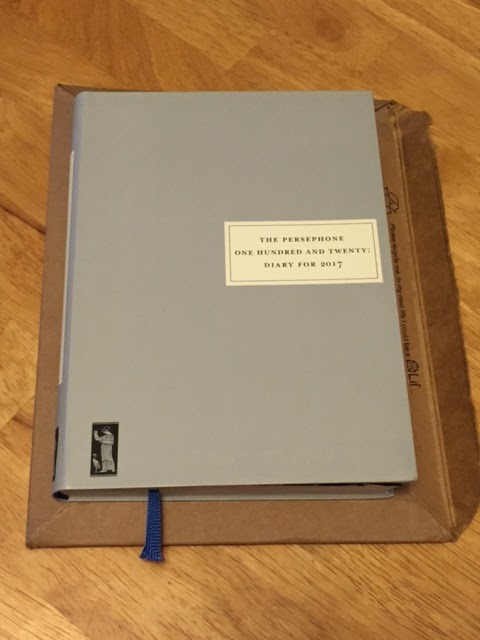
When Persephone Books announced that they would have a 2017 Diary available, I knew immediately that it would be the one for me.  As a burgeoning lover of their aesthetic, as well as their re-published literature, it was an easy decision to make!  Another tick in the Pros column was the discounted price, which was only available through the end of September.  I decided not to dilly-dally, and placed my order straight away.  Including shipping charges, the diary cost right around $25; I ordered mine straightaway.  One week later, I came home to this -

 
Ooooh look at the pristine, luxurious, dove grey cover!


Pulling out the diary, it looks exactly like one of Persephone's traditionally-published books.   The one obvious difference is that, here, a sewn-in, ribbon bookmark is included instead of a paper one that you would receive with the grey editions.  I expect to tote this planner around with me a great deal in 2017, so it's nice not to have to worry about losing the bookmark.


I do wonder why Persephone chose blue ribbon.  With the grey cover, white title card, and black/grey colophon, the blue seems terribly out of place.  A very small gripe, but there it is.  Now back to the positives!

The contents include the same high quality paper, the same thoughtfulness in the details, and the gorgeous endpapers from all 120 books that will be published by the end of 2016. Here are a few particular examples...

Someone at a Distance.  I do wish we had Bank Holidays like they do in the UK.  Le sigh.

Miss Pettigrew Lives for a Day.  A lovely bouquet is so fitting for Valentine's Day week.

In the final pages, you'll find endpapers for the three Persephone books that will be published later in 2016 - Every Good Deed and Other Stories, Long Live Great Bardfield, and Madame Solario.  I won't spoil them here, but rest assured that they on equal loveliness footing as the other 117 selections.  There are also a few pages set aside for notes and other scribblings.

The 2017 diary endpapers from the forthcoming Madame Solario

Whilst the Persephone Books 2017 diary is a bit weightier than other, more conventional options, I will absolutely carry it with me.  It is a gift to myself that I shall treasure throughout the year, even during those times when stationery isn't at the forefront of my thoughts.


Librorum annis


Thursday, September 22, 2016

Unusual Narratives - "Multiple Choice" by Alejandro Zambra

How do you approach a work of fiction that is structured like the Chilean college entrance exam?  When I first heard about the book Multiple Choice by Alejandro Zambra, I was intrigued because it seemed like such a bonkers premise.  How could someone tell a story through this kind of alternative/non-narrative form?  As soon as I was able to obtain a copy, I dove in to experience it for myself.

The text is divided into sections with titles that you might encounter on any standardized test.  Within each section are questions structured like those a student may come across on the Chilean Academic Aptitude Test, however the actual content serves a very different purpose.  To further the narrative trope, in the back of the text is an "answer sheet" with bubbles to fill in which correspond to the answer chosen for each question.


The questions themselves are the actual stories, but this isn't obvious at first.  When I began reading the first section "Excluded Term", I really did mark down my answer for each question, thinking that maybe there would be some narrative that would become clear from those answers.  However, I was unable to pinpoint any cohesive storyline that would satisfactorily connect all 24 questions/answers.  Therefore, I figured that this first part of the text was made up of 24 pieces of what I'll call nano-fiction.  Characterization and/or emotion are present, and the fact that the author can accomplish this with only a single word, followed by four multiple-choice answers, is proof of Zambra's talent.

 The author gradually expands his storytelling as the book goes along.  In the second section "Sentence Order", the reader must arrange the presented sentences into the "correct" order.  Depending on the arrangement, a unique narrative becomes evident for each of the 11 questions.  Because the questions/stories are a bit longer than in the previous section, and contain more detail, I would categorize this part of the book as micro-fiction.


The third section of the text is called "Sentence Completion", and presents 17 sentences/paragraphs in which the reader must choose the correct word(s) to complete the sentence(s).  While still being micro-fiction, this is the most interactive portion of the text so far because the reader has the power to completely change the narrative based on what word(s) are chosen.  This section truly gives the reader power to make the story her/his own.  More micro-fiction follows in the next part, "Sentence Elimination".  As the name suggests, the reader is allowed/encouraged to make the included 11 stories as she/he sees fit by removing portions based on options presented in the multiple-choice answers.


The final section of the book, "Reading Comprehension" presents the longest-form stories in the entire book.  They are each around 10 pages long, and are followed by seemingly critical thinking-type questions.  However, the way that the questions are phrased, as well as the wording of the multiple-choice answers, has snarky, darkly-lit humor.  These stories are, despite their brevity, heartrending and very clever.

The fact that the reader is necessarily involved in the telling of the stories is evidence that the author is welcoming of individual interpretation of the material.  This goes against the nature and purpose of a standardized test, which requires ever test-taker to identify the same correct answer to the same question.  Individuality vs. collectivism.  Critical thinking vs. rote memorization/cheating.  Not only is the author using flash fiction (nano/micro/etc.) to comment on the world around him, he is also utilizing the aptitude test format to comment on the idea that students have learned how to take the tests, not how to think.


It's quite difficult to categorize Multiple Choice, because it does not follow anything remotely resembling a traditional narrative.  Using the structure of a standardized test is a unique constraint, because it forces the author to be economical and precise with the words used.  Yet, it's not so contrived that the author's voice is lost.  There is a playful, sarcastic, devastatingly human soul in this pseudo-test.  Overall, a unique reading experience and a beautifully executed work.


Librorum annis