Monday, November 28, 2016

Black Friday & Small Business Saturday Haul

Black Friday is supposed to be the big shopping day of the year, happening on the day after Thanksgiving.  Shops offer deep discounts on some items, in an attempt to bolster their bottom lines before the end of the year.  More and more retailers are starting their Black Friday sales on Thanksgiving Day, some as early as 3:00pm... with economists coining the term "Grey Thursday".  There is also a recent "holiday" called Small Business Saturday...meant as an antidote to the chain stores and other large retailers who typically rule the Black Friday scene.  It's meant to encourage shoppers to remember their small, local businesses amongst the madness of shopping at big box stores.

From the bookish stores I visited, these are my purchases...
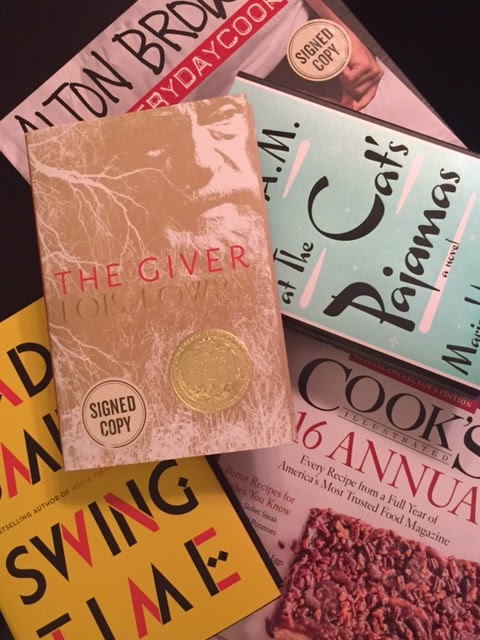
  • Barnes & Noble had advertised for Black Friday that their stores would have limited stock of some autographed books.  I was on a mission to buy Alton Brown's new cookbook Everyday Cook as a Christmas gift for a friend, and I couldn't resist snagging a signed copy of my childhood favorite novel The Giver by Lois Lowry.
  • Barnes & Noble also had a promotion of 30% off all periodicals, so I bought the latest edition of Poetry Magazine, and the Cooks Illustrated compendium of Best Recipes of 2016.
  • I spent a bit of time on Saturday browsing a small, secondhand bookshop and came out with a first edition hardcover of one of my favorite Christmastime novels 2 A.M at the Cat's Pajamas by Marie-Helene Bertino.  It takes place on Christmas Eve eve and follows a chain smoking, jazz singing little girl, Madeline Altimari, as she lives her life in Philadelphia.  As someone who lived in Philly for many years, I love returning to it and its colorful residents in fiction!
  • A few months ago, I had pre-ordered Zadie Smith's new novel Swing Time from the Politics & Prose bookstore in Washington DC.  If you pre-ordered the book within a certain timeframe, you would be sent a Swing Time matching tote bag along with the book.  This was reason enough for me to buy the book, but then I saw that P&P was hosting the author a few days after the book's release, and she would be signing copies.  In my online order, I asked if there was any possibility that they could hold my copy of the book, so that it could be signed, and then send the autographed book along with the tote bag.  I was prepared for a resounding "nope", but they actually agreed!!  Seriously, their customer service is top-notch...I cannot say enough good things about Politics & Prose; I just wish that I lived closer, so that I could visit them in person.  Although I didn't place my order on Black Friday, the fact that the shipment arrived on Black Friday means that it counts, right?  Right!


Overall, this shopping weekend was relatively productive...I still have a few more bookish gifts to buy before Christmas, but I'm off to a good start.  If you did any bookish shopping during the Black Friday weekend, what did you buy?  Are there bookish gifts you're looking to acquire?


Librorum annis


Thursday, November 24, 2016

A Bookish Thanksgiving

Today is Thanksgiving Day here in the USA, which for many of us involves the following...


Gathering together with friends and family 

Eating a huge meal 


Watching whatever sports teams happen to be playing


Napping


Waking up and going Black Friday shopping


It's commonplace, during the meal, for each person around the table to share something for which he/she is thankful.  In that spirit, I would like to share the bookish things for which I am most thankful!


I am thankful for...

  • Authors, writing today, who shine a light where there is darkness:

  • My local bookshops and public libraries, which offer not only a wonderful selection of reading options, but function as safe spaces and gathering places for the community.

  • Persephone Books - A small, British publishing house/bookshop that I first came upon this year, who bring choice reprinted works back into the world, accompanied by dove grey covers and stunning endpapers.  Through Persephone's catalog, I have added two authors to my "Favorites" list: Dorothy Whipple and Mollie Panter-Downes.

  • Translated literature, and the hard-working translators, for giving English-reading consumers diverse perspectives and insights.
  • Litsy - This new app combines the best of Goodreads and Instagram, and is one of the most bookish, supportive, and positive communities on the Internet.


  • My local bookshops and public libraries, which offer not only a wonderful selection of reading options, but function as safe spaces and gathering places for the community.
  • Independent presses - Publishing works that are often more experimental, more unique, and (in my opinion) more interesting than the offerings from more traditional presses.  Thank you for doing your brave work.  You can find a listing (not necessarily comprehensive) of indie book publishers here.


  • Fiction, for telling us as much about ourselves and our world as any of the characters we might find within the pages.
  • Non-fiction, especially those works which challenge the inaccurate, pervasive, dominant, historical narratives in society


Librorum annis


Book Review - An Indigenous Peoples' History of the United States by Roxanne Dunbar-Ortiz


As I write this, thousands of individuals are engaging in peaceful protests alongside the inhabitants of the Standing Rock Native American Indian Reservation. They are protesting the building of the Dakota Access Pipeline, an oil pipeline that would traverse directly through the Reservation's only water source. The building project would also desecrate sacred lands including burial sites and ritual grounds. The response by local and state law enforcement has been harsh, violent, and inhumane - following the historical precedent for treatment of Native Americans - as described by Roxanne Dunbar-Ortiz in her book An Indigenous Peoples' History of the United States.

American schoolchildren are taught a specific narrative when it comes to the beginnings of the United States. Based on the concepts of Virgin Land, white supremacy, and Manifest Destiny, they learn that the pilgrims fled religious intolerance in England and came to the New World in search of a better and more tolerant way of life. These pilgrims found vast, untouched wilderness all around them, and took it as self-evident that God wanted them to claim this land to build, conquer, and prosper. Other than a few natives who helped those pilgrims in their first year of life in the new land, the indigenous peoples they encountered were savage, bloodthirsty, war-wagers who had to be annihilated. This narrative, categorized unquestionably by Dunbar-Ortiz as a fairy tale, has been used to justify the treatment of Native Americans for hundreds of years. However, when looked at the situation from a historically accurate, objective perspective it can only be called genocide.

The nations of indigenous people of the Americas had sophisticated, respectful, advanced systems of culture, science, religion, and agriculture. They maintained peace with each other unless war was absolutely necessary. The interstate highways and other major roads that Americans drive upon originated as Native American-built trade and migration paths. By most accounts, they were quite modern. However, because their traditions and methods were vastly different from the Europeans who came to claim the land, they were deemed sub-human and savage. Either they were forcibly removed from their lands, so as not to interfere with the settlers' work in colonizing, or were destroyed through violence, intentional spreading of disease, alcoholism, and mandatory assimilation. Large populations of Indian children were regularly kidnapped from their parents and placed into boarding schools meant to deprive them of their indigenous way of life.

The fledgling American government would often make treaties with the Native American nations, on-paper allowing for some self-governance and land rights. However, when the treaties became inconvenient for the government, politicians and military would often either not enforce the rules or would invalidate or remove them altogether. All the while, under the guise of Manifest Destiny, white settlers decimated the natural resources and lands. Whole species of animals were destroyed to near-extinction. Poor agricultural practices led to the destruction of topsoil, which resulted in the Dust Bowl. Any indigenous people were considered hostile to the growth of the nation; settlers and military members were rewarded with monies for presenting Native American scalps. The bloody bodies left behind, after the scalps were collected, form the basis for the term "redskin" that has been used as a racial slur towards the indigenous people.

While the focus of this non-fiction work is the history of the USA from an indigenous peoples point of view, the author also includes information about the conquest and domination of other areas including North Africa, the Caribbean, Central and South America, Mexico, and the Pacific.  She also incorporates other historical genocides, like the Crusades and the Holocaust, drawing connections between them and the Native Americans.  She draws a direct comparison between the early settlers' imperialistic ideology and the brutal military response to the indigenous peoples, with the fact that American military maintains bases on countries around the world. The budget for these forces is larger than the military budgets of all other countries combined. The fact that the generic term, used by American forces, for enemy lands is "Indian Territory" or more commonly "In Territory", should not be forgotten.

In An Indigenous Peoples' History of the United States, Roxanne Dunbar-Ortiz challenges the enduring national narrative of the founding of the country. Instead of the heroic settlers taking on the savage and brutal Indians, the research has proven that the opposite was true. Indigenous peoples lost their land due to illegal seizure and genocidal activities of the white settlers, with no concern for the legacy and impact of their activities. Native Americans have historically been seen as an inconvenience to be either assimilated or destroyed. They represent non-Capitalist traditions and ways of life, which go against American "progress". This is why the protests at Standing Rock have been dealt with so harshly by law enforcement. To remove the dominant origin myth and replace it with a historically accurate portrayal of the country's founding and development would mean a significant change in mindset, and coming to terms with the genocidal activities of our founders and family members. But just because it's difficult doesn't mean it shouldn't take place.


This is an important book, with a vital message, and is the perfect compliment to today's Thanksgiving holiday.   


Librorum annis