Showing posts with label Monthly Reading Wrap Up. Show all posts

Monday, October 30, 2017

October Reading Wrapup

October was an interesting reading month for me.  I started off the first week or so reading absolutely nothing.  Then, I got my book-footing and read a whole bunch.  In total, I read 9 books in October.


The Art of Failing, by Anthony McGowan (read as an ebook) - A humorous glance into daily life in West Hampstead, London, with the author, Anthony McGowan.  Structured as a diary and organized by season, there are daily-ish entries outlining something humorous/bizarre/unexpected that happened to the author that day, or at least a noteworthy observation.

The Circle Game, by Margaret Atwood - Published in 1964, this is Margaret Atwood's first commercially-published poetry collection and it explores womanhood, colonialism and indigenous peoples, environmentalism, and many other topics.

Madwoman, by Shara McCallum - In this powerful collection of poems, Shara McCallum calls upon folklore and traditions from her native Jamaica as well as modern day experiences and microaggressions.  There is clear, strong feminism that permeates throughout the work, that grabs the reader from the beginning.  The author plays with language in very deliberate ways, interplaying rhyme, free verse, patois, and lots of symbolism.

A Year in Provence, by Peter Mayle - When Peter and his wife move from their home in Devon, England to the South of France, it is a culture shock to say the least.  They learn that time is thought of in seasons rather than hours or days, good food and wine are vital, and construction projects where the contractor uses the phrase "Normally..." are not going to be completed anytime soon.

Candide, by Voltaire - In the early eighteenth century, Gottfried Leibniz published his Theodicy, in which he purported that the world we're living in is the best of all possible worlds, because it was created by God.  No matter the suffering, violence, poverty - it is the best world.  This worldview is commonly called "philosophical optimism", and Voltaire disagreed vehemently with it.  He wrote Candide as a satirical take-down of Leibniz's approach, as well as many of the literary traditions of the time

The Diamond as Big as the Ritz, by F. Scott Fitzgerald - In this strange little novella, published in 1922, John T. Unger leaves his well-to-do family in Hades, Mississippi to attend a prestigious men's boarding school in Boston.  While there, he befriends a fellow student named Percy Washington.  John knows that Percy, a keep-to-himself kind of guy, is very wealthy, but he has no idea just how right he is until he is invited to summer with Percy at his family's home in Montana. 

Lord of the Flies, by William Golding - I appreciate the plot of this story (plane crashes on deserted island and only a group of schoolboys survives and has to forge its own society) but I take great offense to the choices in gender and overall characterization, as well as the use of the term "savage" as the author chose to employ them.  I would love to see (if there isn't already one out there...let me know if there is!) a modern interpretation of this book, where the cast of characters show more diversity and sensitivity.

Horrorstor, by Grady Hendrix (read as an ebook) - When an Ikea-esque store called "Orsk" begins experiencing strange phenomena, manager Basil recruits two of his employees, Amy and Ruth Ann, to work a covert, overnight shift to figure out exactly what is going on.  But what is going on is so much more than anyone had bargained for.

The Five Children and It, by E. Nesbit - The story features four elementary school-aged siblings - Cyril, Anthea, Robert, and Jane - and their infant brother Hilary during a summer spent in Kent.  During playtime at a gravel quarry, they uncover a sand-fairy who offers to grant them one wish every day.  Whatever they wish for will last for only that day; when the sun sets everything will go back to the way it was before.  They wish for things as children would, which is to say naively.


Now that we're almost into November, it's time to start thinking about all the non-fiction that I want to read during the annual Non-Fiction November challenge.  Stay tuned for more details on that...


Librorum annis,


Thursday, September 28, 2017

September Reading Wrapup

Compared to my last few months, September's reading quantity is a little bit sad.  In comparison to most Americans' reading, however, it's stellar!  Despite a reduced quantity, the quality of the books this month was pretty darn great.  And let's be real, I knew that I couldn't keep up a 20-book-per-month reading pace for very long.  I expect that the next few months of reading in October (and November) will be around the same amount as in September, due to travel/holidays/other work-life requirements.  Small of quantity, but not of quality!

Here are September's harvest of books...


Coming to My Senses: The Making of a Counterculture Cook, by Alice Waters
A Portrait of the Artist as a Young Man, by James Joyce
A Far Cry From Kensington, by Muriel Spark (audiobook)
What Happened, by Hillary Rodham Clinton


Sourdough, by Robin Sloan
We Wear the Mask: 15 True Stories of Passing in America, edited by Brando Skyhorse and Lisa Page
Tears We Cannot Stop: A Sermon to White America, by Michael Eric Dyson


Herland, by Charlotte Perkins Gilman
I Shall Not Be Moved, by Maya Angelou
Mr. Penumbra's 24-Hour Bookstore, by Robin Sloan
Cheers to September, the beginning of autumn, and great books!


Librorum annis,


Thursday, August 31, 2017

August Reading Wrapup

After the great gaggle of books completed last month, I had a slightly less voluminous reading month in August.  There were some books I enjoyed more than others, and the topics covered in these works are as varied as the forms in which I read them.  Here's the rundown -


Bitch Planet Volume 1, by Kelly DeConnick and Valentine De Landro (digital comic)
Middlemarch, by George Eliot
Astrophysics for People in a Hurry, by Neil de Grasse Tyson (audiobook)
Why Poetry, by Matthew Zapruder
A Small Place, by Jamaica Kincaid
Department of Speculation, by Jenny Offill (audiobook)


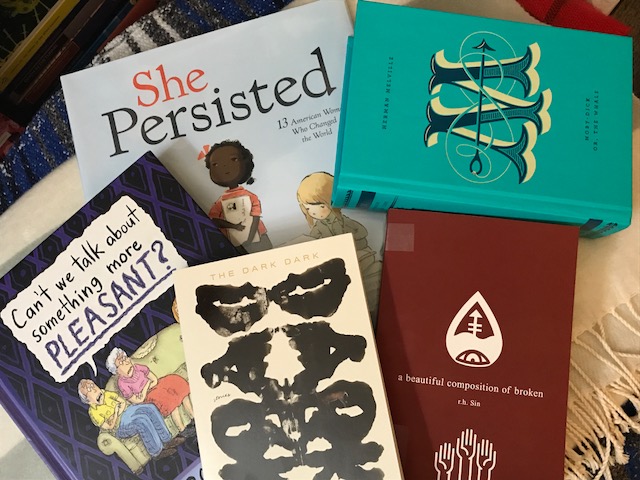
A Beautiful Composition of Broken, by R.H. Sin
Moby-Dick: or, The Whale, by Herman Melville
She Persisted: 13 American Women Who Changed the World, by Chelsea Clinton
Can't We Talk About Something More Pleasant, by Roz Chast
The Dark Dark, by Samantha Hunt
The Anti-Inauguration: Building Resistance in the Trump Era, by Haymarket Books (e-book)


Here's hoping that September is another fulfilling month of reading!  What did you read in August?

Please note - there will not be a new post until September 7th.  Have a happy long-holiday-weekend, everyone!


Librorum annis,


Monday, July 31, 2017

July Reading Wrapup

When I think back to the books I read in June, most of them were heavy with important social, political, and cultural issues.  They were shocking, informative, inspiring.  I was reading with a determined purpose, and those books directly reflected it.  It looks like maybe my reading inclination shifted slightly in July.  Classics of the Western Cannon, a YA love story, historical fiction, and the just-plain-bizarre played alongside xenophobia, racism, and religious intolerance.  I guess my July reading is.....well rounded?  It's also plentiful!  Partly, this is due to the shorter books that I read (poetry, novellas) but also because of the #24in48 Readathon that happened.  A 48-hour span of time completely dedicated to reading?  Yes please!

Here are the 24 (the most I've ever read in a single month!) books that I read in July:


Autopsy of a Father, by Pascale Kramer - review here
The Abridged History of Rainfall, by Jay Hopler - Throughout this poetry collection, Jay Hopler takes you on journey across time, space, and emotion - masterfully capturing the human condition and its impact on the natural world.  There is also a strong sense of play throughout, especially through the poet's word choices, rhythms, and creative phrasing.  This is an immensely beautiful collection of poetry, and one I know that I will return to again and again.
Great Expectations, by Charles Dickens - The well-loved classic about Pip and the Great Expectations he, and his mysterious benefactor, have for him.
Quoof, by Paul Muldoon - Paul Muldoon is a lover of language and its many forms, interpretations, and interminglings.  In this poetry collection, he explores animal sounds-as-language, punctuation, cultural word-use variations, and differences in English, from his native Northern Ireland and the United States.
My Mother Was a Freedom Fighter, by Aja Monet - review here


When Dimple Met Rishi, by Sandhya Menon (audiobook) - This is a very sweet YA romance about the intersection of Indian and American culture, romance, and computer science.
The Nakano Thrift Shop, by Hiromi Kawakami - The book covers a few years in the life of a Japanese trinket shop, the items that come in and out of it, and the quirky and lovable people who come into contact with it.  It is the intermingling of the characters, trinkets, and plots that makes this book an absolute delight to read.
Ella Minnow Pea, by Mark Dunn - Are you a lover of words and language?  Is freedom of expression important to you?  Do you value critical thinking and rationality over blind adherence to dogma?  Would you be willing to sacrifice your principles and better judgment in order to gain acceptance?  These are questions you'll grapple with throughout this book.
What We Lose, by Zinzi Clemmons - Have you ever been so overcome with a cocktail of depressive emotions...exhaustion, longing, sadness...that you begin to lose your grasp on time?  That is the hazy experience captured by Zinzi Clemmons in her novel.
Even This Page is White, by Vivek Shraya - It's not only the creative use of imagery that's remarkable about this poetry collection.  It's the the playful and hard-hitting employment of language.  It's how the poet frames her subjects, coming at them from directions you wouldn't expect.  The poems celebrate, challenge, reinforce, reverberate.


Ordinary Light, by Tracy K. Smith (audiobook) - In this extraordinary memoir, Tracy K. Smith takes us not only through her own life, but into the complex relationship she shared with her mother.  It was the death of her mother from cancer that motivated Tracy to take on this project, and the sorrow and searching in the wake of this loss are tangible throughout the work.
Siddhartha, by Herman Hesse - The story about a young man's search for enlightenment and truth throughout his life
The Woman in Cabin 10, by Ruth Ware - A mystery/thriller about a woman on a luxury cruise yacht who witnesses what she thinks is a murder
Such Small Hands, by Andres Barba - The story of orphaned 7-year old Marina, her doll Marina, and the other girls at the orphanage where she is sent.
Margaret the First, by Danielle Dutton (audiobook) - In this work of historical fiction, the reader follows Margaret Cavendish throughout her life.  But think ye not that it is dry, uninspired, or uneventful.  In fact, rather than laying out a traditional biography, Danielle Dutton takes the reader inside the mind of Margaret - simultaneously into her deep introversion and desire for notoriety.  It's the interplay of these two motivations in her life, along with the beautiful writing, that makes this a joy to read.


Urgent Unheard Stories, by Roxane Gay - This is a short and sweet collection of essays that meld bibliophilia, pop culture, and social justice.  In true Roxane Gay style, she makes you laugh, makes you think, and makes you feel.
The Wangs vs the World, by Jade Chang - This novel is a truly madcap family road trip, like a slightly more woke version of National Lampoon.
Nothing More to Lose, by Najwan Darwish - A poetry collection, by a Palestinian writer, that is full of religious, social, cultural, and familial upheval.
The Little Buddhist Monk and The Proof, by Cesar Aira - These novellas are grounded in a visceral reality that I could clearly place myself into, but that reality is punctuated by bits and pieces of the surreal.
When I Was a Child I Read Books, by Marilynne Robinson - In true Marilynne Robinson style, these essays interweave threads of religion, science, literature, and personal experience to talk about important issues.


A to Z of American Women Leaders and Activists, by Donna Langston - An encyclopedia of American women activists, leaders, and visionaries.  Even if you've studied women's history or other related courses, you'll probably find someone here who is new to you. 
Madame Bovary, by Gustav Flaubert - French classic about a woman frustrated by her circumstances and gender.
City Lights Pocket Poets Anthology - A huge array of poems, many of the Beat Generation, republished by the City Lights Press in San Francisco.   
The Handmaid's Tale, by Margaret Atwood - Dystopian tale about a conservative religious order that takes control of the Eastern part of the United States and separates the citizenry into castes.


And that's it for my July reads - a really diverse and interesting mixture of books!  What did you read in July?  What are you looking forward to in August?


Librorum annis,


Thursday, June 29, 2017

June Reading Wrapup

There are times when the books I read fall into themes, sometimes intentionally and sometimes not.  From December 21-March 20, I undertook my self-imposed "Winter of Women" project.  Other times, I base my reading on monthly observances, like Black History Month in February or Poetry Month in April.  Other times, themes emerge much more organically and spontaneously.

Such was the case in June.  Maybe I'm dealing with feelings about the state of my country & the world right now.  Maybe it's a desire to keep myself informed.  Maybe I need, on some level, to know that I'm not the only one who is shocked, angry, and grieving.  Maybe just enough time passed that I now have the headspace to begin delving into these topics in earnest.  Whatever the reasons, you can see from the books I've read that this could be called "Social Justice June".  All of the books deal with pertinent issues: Racism, sexism, treatment of immigrants, war crimes, US/Mexico relations, environment, corruption, protest, feminism, and civil rights.  Even Samantha Irby's essay collection, which is heavily steeped in hilarity, dealt with serious topics.  It was a heavy but helpful month -


Signs Preceding the End of the World by Yuri Herrera (fiction)

The Transmigration of Bodies by Yuri Herrera (fiction)

Cold Pastoral by Rebecca Dunham (poetry)

A Fugitive in Walden Woods by Norman Lock (fiction)

We Are Never Meeting in Real Life by Samantha Irby (essays)

My Antonia by Willa Cather (fiction)


Radical Hope: Letters of Love and Dissent in Dangerous Times edited by Carolina De Robertis (essays)

What We Do Now: Standing Up for Your Values in Trump's America edited by Dennis Johnson and Valerie Merians (essays)

The Mother of All Questions by Rebecca Solnit

The Destruction of Hillary Clinton by Susan Bordo [non-fiction (audiobook)]


It Can't Happen Here by Sinclair Lewis (fiction.....or is it?!)

Resistance, Rebellion, Life: 50 Poems Now edited by Amit Majmudar (poetry)

Guantanamo Diary by Mohamedou Ould Slahi (non-fiction)


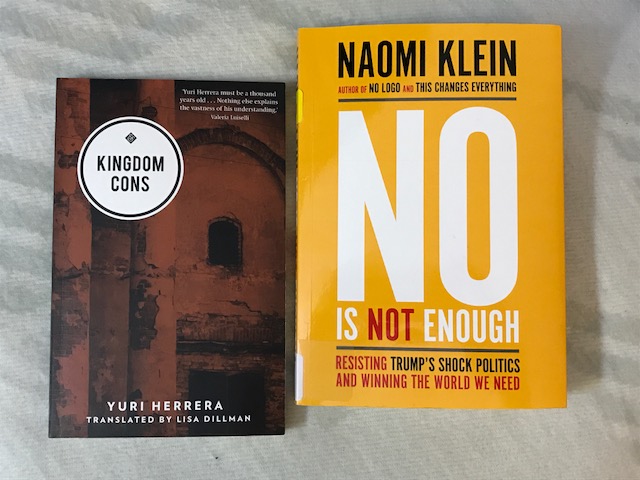
Kingdom Cons by Yuri Herrera (fiction)

No Is Not Enough: Resisting Trump's Shock Politics and Winning the World We Need by Naomi Klein (non-fiction)

Sister Outsider: Essays and Speeches by Audre Lord [non-fiction (audiobook)]


It'll be interesting to see what forms, if any, my July reading takes.  Will there be a dominant theme?  I guess we'll have to find out by the end of next month.  What books did you read in June, and were there any interesting patterns or themes?


Librorum annis,


Monday, June 5, 2017

May Reading Wrap-Up

May started out slowly, but turned out to be quite a satisfying reading month. There was diversity in the genres, subjects, and formats of the books that I read...from poetry to a hilarious memoir, to some hard-hitting non-fiction.  I thoroughly enjoyed each and every book, and hope that you might be inclined to pick up one of these for yourself. 


Motherland Fatherland Homelandsexuals, by Patricia Lockwood
A Fragile Freedom: African American Women and Emancipation in the Antebellum City, by Erica Armstong Dunbar
Radium Girls: The Dark Story of America's Shining Women, by Kate Moore
Priestdaddy: A Memoir, by Patricia Lockwood


The Guest Cat by Takashi Hiraide
The Joy of Leaving Your S*it All Over the Place by Jennifer McCartney
Notes on the Assemblage by Juan Felipe Herrera
Aristotle & Dante Discover the Secrets of the Universe by Benjamin Alire Saenz (e-audiobook)


Spring and All by William Carlos Williams
Othello by William Shakespeare
New Boy by Tracy Chevalier
Inferior: How Science Got Women Wrong and the New Research That's Rewriting the Story by Angela Saini


Me Talk Pretty One Day by David Sedaris
Swimming Lessons by Claire Fuller
Envelope Poems by Emily Dickinson
Fever Dream by Samanta Schweblin
Jane Eyre by Charlotte Bronte


Here's a genre rundown....

Fiction - 2
Poetry/Drama - 5
Non-Fiction - 4
Young Adult - 2
Memoir/Essay - 2


What did you read this month, and what are you looking forward to reading in June?


Librorum annis,


Monday, May 1, 2017

April Reading Wrapup

April was a busy month for bookishness.  National Poetry Month, National Library Week, World Book Day, and Independent Bookstore Day all happened this month.  I was also able to squeeze in two author events.  All of this, and I read a total of 13 books!  April was a rather winning month, indeed.  Here are the books!


Catalog of Unabashed Gratitude by Ross Gay (poetry)

This book exists in the Venn diagram of "humanity" and "nature".  Whether it's a fig tree growing miraculously in Philly's Italian Market, a bird hitting a windshield, or lying on the grass during a sunny day, the author beautifully captures the joys and sorrows of when the natural world and the human experience come together.

Never Caught: The Washington's Relentless Pursuit of Their Runaway Slave, Ona Judge by Erica Armstrong Dunbar (non-fiction)

It may come as no surprise that, being wealthy Southern farmers, the Washington's held slaves.  Hundreds of them worked the fields, kept the house, and served the owners of Mount Vernon long before our first President was elected.  This book presents the biography of one of those slaves, Ona Judge, and her experience serving Martha Washington until her escape near the end of George Washington's presidency in Philadelphia.


A Manual for Cleaning Women by Lucia Berlin (short stories)

This is a fascinating collection of short stories that were compiled posthumously by Stephen Emerson.  What is particularly fascinating about them is that, although the individual stories were published in various places during her lifetime, when put together they feel linked.  It's almost as if there is a larger story that the author was trying to tell - the story of her life.  The editor graciously includes background information on Berlin, and after reading it (which I would recommend doing AFTER finishing the collection) the reader can clearly see how the characters in the stories were inspired by her own life experiences.

In Spite of Everything by Curtis Robbins (poetry)

The poet lost his hearing at age 1, and has gone on to a successful academic career - teaching deaf culture and American Sign Language.  This poetry collection entirely centers around the deaf experience, the ways in which it is similar and different from hearing experiences, and profiling some prominent, deaf writers.  If you are interested in learning about deaf culture and perspectives, I would highly recommend this collection.   

There Are More Beautiful Things Than Beyonce by Morgan Parker (poetry)

One of the most ambitious and amazing poetry collections I've ever read.  It's surprising in its scope and also the depth and breadth of emotions it evokes.  It brilliantly mixes pop culture, social justice, and inter-sectional feminist topics with a deep rhythm and bright energy.  The wordplay is whip smart and packs a serious punch.

Greenery Street by Denis Mackail (novel)

A novel (originally published in 1925 and republished by Persephone Books in 2002) that gives readers a glimpse into the first few months in a generally happy marriage.  There are no issues of infidelity or any other serious temptations that might draw partners apart.  Instead, Ian and Felicity represent a devoted couple who are still figuring out how to be adults and how to live with each other successfully.  It's light, delightful, and very sweet.


An Age of License: A Travelogue by Lucy Knisley (graphic memoir)

During this graphic memoir, we follow the author on a whirlwind European trip that turns out to be so much more.  She is initially asked to attend a Comic Con in Norway, to talk about her experiences as a graphic artist and memoirist.  She decides to dovetail trips to Sweden (a love interest), Germany (friends' honeymoon), and France (mother's holiday with her friends) onto this trip.  We follow her as she stresses about making arrangements and packing, and dealing the unpleasant people she has to sit next to on flights.  She's also experiencing that ennui that many mid-20's aged people feel; she's between relationships, uncertain about her career, and constantly comparing her situation to those of her friends.

The Story of My Teeth by Valeria Luiselli (novella)

In this book, we are introduced to Gustavo Sanchez Sanchez (aka "Highway"), a factory worker-cum-auctioneer in a suburb of Mexico City.  He is also a collector - of objects, educational courses, stories, and ideas.  He has an ex-wife, Flaca, and an estranged son, Siddhartha.  This son appears later in his life, in a very sinister and surprising way.  Highway narrates 1/2 of the book, and tells the audience his story.  The next 3/8 of the book is narrated by Highway's "dental autobiographer", Jacobo de Voragine.  The final 1/8 is a chronology of historical events (called "The Chronologic") written by Christina MacSweeney.


Thing Explainer by Randall Munroe (non-fiction)

What the author does masterfully is to take complex, often technical, ideas and explain them in the most simple language.  This allows people of all language and education levels to learn and appreciate the concepts.  You won't need an advanced degree in engineering or chemistry to be able to understand this book.

Big Mushy Happy Lump by Sarah Andersen (graphic novel-comics)

A hilarious and completely self-conscious look at modern, female life.  Whether it's stealing your significant other's clothes, posting cat photos on the internet, or dealing with your monthly issues, this book covers it all.

Footnotes From the World's Greatest Bookstores by Bob Eckstein (non-fiction)

This is a beautifully crafted book, and would be a lovely gift for a lover of books, but especially for a lover (and visitor) of bookshops.  The author has curated a collection of diverse bookshops around the world, provided a brief overview (at most, a few sentences), some testimonials from authors or other bookish people, and a beautiful drawing of the building.  I found myself flipping through the book, picking out the ones I've visited and noting the ones I want to visit.

Tell Me How It Ends: An Essay in Forty Questions by Valeria Luiselli (essay)

For those who aren't well-informed about the realities of immigration, this essay will be an awakening.  The dominant political rhetoric in the US does not at all reflect the truth, and actively avoids admitting culpability in the root causes for this immigration...which should really be called "seeking asylum".  These children are fleeing their home countries because there is no future without violence and poverty.  They are willing to risk everything for a chance at a better life.  If that isn't the American Dream, then I don't know what is.


The Hate U Give by Angie Thomas (fiction)

The book centers around the modern day Black Lives Matter movement, but also gives some history and background information of what came before it.   It doesn't shy away from the hardships experienced by disadvantaged people, but gives those people the humanity that media outlets often don't. People are people; we all deserve justice, fairness, and truth - no matter our outward appearance.  That is the message of this novel, and this message is vital for us all to hear.


I'm looking forward to what May has in store!  Happy reading!


Librorum annis,


Thursday, April 6, 2017

Winter of Women 2017 Wrapup and Reflections

In the later part of 2016, I took stock of my reading habits.  I've been interested in reading more books written by women and people of color, however my reading wasn't reflecting it.  So, I made a decision and created a reading challenge for myself.  Beginning on December 21st, the first day of winter, and ending on the first day of spring, I would read only books written by women.  You can read more about the impetus to the project here.  And because I good track record of completing projects when I give them not only a deadline but a catchy title, I decided to name this my Winter of Women 2017.

I didn't read very much between December 21 and the end of 2016, with holidays and their various requirements of my time.  I only managed to read two books, and 2AM at The Cat's Pajamas is one that I re-read every year on Christmas Eve eve, because that is the book's setting:


  • Hag-Seed by Margaret Atwood
  • 2AM at The Cat's Pajamas by Marie-Helene Bertino

January was packed full with my teaching a night class at the local university, my birthday, and some very busy hours at my day job.  However, the #24in48 Readathon took place in January, so I was able to cram a bunch of books in there and bump up my month's reading...


  • A London Child of the 1870's by Molly Hughes
  • Unmentionable: The Victorian Lady's Guide to Sex, Marriage, and Manners by Therese O'Neill
  • Pride and Prejudice by Jane Austen
  • Talking as Fast as I Can by Lauren Graham
  • M Train by Patti Smith
  • Difficult Women by Roxane Gay
  • The Summer Without Men by Siri Hustvedt
  • Other Stories and Other Stories by Ali Smith
  • The Grownup by Gillian Flynn
  • The Closed Door and Other Stories by Dorothy Whipple
  • Homesick for Another World by Ottessa Moshfegh
  • Sad Animal Facts by Brooke Barker
  • The Princess Diarist by Carrie Fisher
  • Ms Marvel Vol. 1: No Normal by G. Willow Wilson and Adrian Alphona

February is Black History Month, so I decided to focus exclusively on books written by Black women during this month.  The only exception is the poetry collection by Claudia Emerson, which I began reading in January and finished in February. Despite it being an outwardly busy month, with not much time for reading, I finished some great books...


  • White Teeth by Zadie Smith
  • Love Is Love: A Comic Book Anthology to Benefit the Survivors of the Orlando Pulse Shooting by various writers/artists
  • Late Wife by Claudia Emerson
  • Hidden Figures: The American Dream and the Untold Story of the Black Women Mathematicians Who Helped Win the Space Race by Margot Lee Shetterly
  • Like One of the Family by Alice Childress
  • Mules and Men by Zora Neale Hurston
  • Freedom Is a Constant Struggle by Angela Y. Davis

I had initially decided that I would conclude the #WinterOfWomen17 project on March 21, which is the first day of Spring.  However, March is Women's History Month, so I decided to extend my female-only reading through the end of March.  Life has calmed down significantly this month, so I was able to read the most books yet of any month in 2017...


  • Glaciers by Alexis M. Smith
  • Relish: My Life in the Kitchen by Lucy Knisley
  • To Bed with Grand Music by Marghanita Laski
  • Frantumaglia by Elena Ferrante
  • Memoirs of a Polar Bear by Yoko Towada
  • Hope in the Dark by Rebecca Solnit
  • The Mothers by Brit Bennett
  • Voyage of the Sable Venus by Robin Coste Lewis
  • Word By Word: The Secret Life of Dictionaries by Kory Stamper
  • Things We Lost in the Fire by Mariana Enriquez
  • Dear Ijeawele or A Feminist Manifesto in Fifteen Suggestions by Chimamanda Ngozi Adichie
  • The Lost Daughter by Elena Ferrante
  • Dark Sparkler by Amber Tamblyn
  • Why I Am Not a Feminist: A Feminist Manifesto by Jessa Crispin

Whew, those were a wholelotta lists!  Here's what this whole project looked like, at a glance:
37 books read
3 poetry collections
10 books by women of color
13 non-fiction/essay collections
3 graphic-based books
8 short story collections


Why take on a targeted project like this, limiting myself in what I could read?  What could it possibly accomplish?  Why bother?

First of all, it wasn't a hassle or hindrance to find books written by women.  They are available everywhere, brought out through all manner of publishing.  There were no libraries, bookshops, or other retailers where I couldn't find female authors' work.  I'll admit that, although I had more than enough books to read for the whole project on my own shelves, I also borrowed some from my local libraries.  New releases, backlist, older works...it was a delight and a joy deciding which books to read every month.    

Second, I wanted to make a concerted effort to make my reading more female-centric.  Most of my literary education was made up of books written by men, including those that are commonly regarded as "classics" or "books everyone should read".  The reasons for this kind of classification, and their overwhelming masculinity and dudeliness, befuddle me.  I wanted to explore a variety of women's voices to discern if there were significant differences between them and those of their male comrades.
After completing #WinterOfWomen17 I believe wholeheartedly that women authors (and women in general) are just as capable, talented, empathetic, curious, scholarly, artistic, creative, and deserving of praise and attention as men.  Both genders write in all the styles, and do so successfully.  Fiction, non-fiction, poetry, and any other form written by women is not any less valuable than those written by men.  Will I make it a permanent change - only reading books by women for the rest of my life?  Decidedly not.  Not only do I have many male authors' books sitting unread on my shelves, but there will be new/republished works I will certainly be interested in reading.  However, I will think a little more before I blindly reach for a book written by a male author.


Librorum annis


Thursday, March 2, 2017

February Reading Wrap Up

February is Black History Month, and at the beginning of the month I challenged myself to read only books written by black women.  I've been continuing to read only books written by women as part of my Winter of Women Project, and this was an added level of challenge for me...and I was mostly successful with it!  Out of the 8 books I read in February, only two were not written by black women.   One of these two books was a re-read, and the other was a poetry collection I had started reading in January, and carried over into February.

Here are the books I read this month.  If I reviewed the book on this blog, I'll link to it.  Otherwise, I'll include a brief review of it here.


  • White Teeth by Zadie Smith (fiction, ebook) - REVIEW
  • Love Is Love by various artists & writers (graphic novel compendium) - REVIEW
  • The Late Wife by Claudia Emerson (poetry, paper) - A heartbreaking portrayal of a love that has ended, with the two lovers finding new paths apart.  The poet takes up the cause of the micro-change, using incremental life adjustments to discuss greater emotional realities.
  • Glaciers by Alexis M. Smith (novella, audiobook) - Full of beautiful and emotionally charged prose, Glaciers presents one day in the life of Isabel, a woman in her late 20's living in Portland, OR.  She works as a damaged books librarian with a small group of others in a library.  The way that her life is presented through mostly flashbacks, Isabel is herself a glacier - only a small portion of who she is floats above the surface.  There is so much more to her just below.
  • Hidden Figures by Margot Lee Shetterly (nonfiction, ebook) - A beautifully written and painstakingly researched account of the lives and careers of three brilliant, pioneering, African American women mathematicians whose contributions to aeronautics and space exploration may have been otherwise lost to history.  The work frames these women and their achievements with the greater societal pressures and expectations of the decades in which these women worked, including the arcane Jim Crow segregation laws.
  • Like One of the Family by Alice Childress (fiction, paper) - REVIEW
  • Mules and Men by Zora Neale Hurston (fiction, paper) - A collection of 100 pieces of African American folklore and storytelling recorded between 1928 and 1932 by the author.  She focuses on the area in and around Eatonville, FL where she grew up, and New Orleans in Louisiana.
  • Freedom Is a Constant Struggle by Angela Y. Davis (nonfiction, audiobook) - Angela Davis is a leading and historical figure in the Civil Rights Movement in the USA, as well as being an outspoken Communist and Feminist.  She has inspired countless individuals to rise up and take action against injustice and in support of freedom for all.  Her book, FREEDOM IS A CONSTANT STRUGGLE, is a collection of interviews, conversations, essays, and speeches that tackle the concept of freedom in different ways.  The audiobook is narrated by the author, which lends an extra depth to the material being discussed.


Just about 75% of my February reading was by women of color, which is great, but didn't quite meet my goal of 100% women of color authors for Black History Month.  However, I read some really fantastic books this month, and found authors whose work I will definitely continue reading in the future.  I'm already looking forward to what books await me in March - Women's History Month!


Librorum annis


Thursday, February 2, 2017

January 2017 Reading Wrapup


January was a surprising reading month for me.  I didn't expect to get much reading done, because I knew I would be busy at my day job.  In addition I am teaching a class at the local university, and that course started on the second week of January.  Between course prep, business at work, evenings spent teaching, and general life events, I didn't think I'd read more than a handful of books this month.

It turns out that I was very, very wrong!  In fact, I read 15 books this month, in a variety of formats. I've continued with my #WinterOfWomen17 project, and all of these books (except one) are written by women.  One event that helped my reading total reach such heights was my participation in the 24in48 Readathon.  I finished 4 books and read through 75% of a fifth one in the 24 hour challenge.  Another important component was audiobooks. I can read/listen to them as I'm working my day job, so I get through a few extra books that I might otherwise not.

I can only hope that my February will be equally prolific, but with teaching another university course that month, I don't expect it to be so.  Here are the books I read in January, in order of their completion (blog reviews are linked):

  1. A London Child of the 1870s by Molly Hughes (paper book)
  2. Unmentionable by Therese O'Neill (ebook) - Nonfiction about what day-to-day life was like for women in the Victorian period...hygiene, clothing, relationships, civil rights, housekeeping, and more.  A real eye-opener that makes you appreciate modern life!
  3. Pride and Prejudice by Jane Austen (paper book) - The classic of social comedy, romance, misunderstandings, and class in Regency era England.
  4. Talking as Fast as I Can by Lauren Graham (audiobook) - Graham's memoir of growing up and her experiences in theater, TV, and movie roles.  Her role in the original and reboot of Gilmore Girls is the focus of the book.  Graham narrates the book, and is hilarious and poignant.
  5. M Train by Patti Smith (paper book)
  6. Difficult Women by Roxane Gay (paper book)
  7. The Grownup by Gillian Flynn (paper book)
  8. The Summer Without Men by Siri Hustvedt (paper book)
  9. Other Stories and Other Stories by Ali Smith (paper book)
  10. The Closed Door and Other Stories by Dorothy Whipple (paper book)
  11. Homesick for Another World by Ottessa Moshfegh (paper book)
  12. The Little Book of Hygge by Meik Wiking (paper book) - Hygge is a Danish term for the feeling of safety, cosiness, contentment, and warmth.  This little book, written by the CEO of the CEO of the Happiness Research Institute in Copenhagen, explores hygge in all its applications, without focusing on retail pursuits.
  13. Sad Animal Facts by Brooke Barker (paper book) - A sweet book of interesting facts on 152 animals, paired with cartoonish drawings and funny comments.
  14. The Princess Diarist by Carrie Fisher (audiobook) - Fisher narrates this memoir of her early acting experiences, but focuses on the romantic relationship she had with Harrison Ford during their time together filming the Star Wars movies.  At time it feels a bit voyeuristic, but overall a fascinating read.
  15. Ms. Marvel Volume 1 by G. Willow Wilson (graphic novel) - A 16 year old Muslim girl from Jersey City, NJ becomes the recipient of superpowers and fights evildoers in her community.  She also has to navigate life as a modern, American teenager with her parents, who are traditionalists.  

As for February, I have a sneaking suspicion that I won't be reading nearly as many books as I did this month.  Differences in work schedules and other commitments that take place during February will probably impact the quantity of books I can read.  But I won't let quantity affect quality!  I'll be honoring both Black History Month and my #WinterOfWomen17 project in my reading choices next month.  I will be reading only books authored by Black women during the month of February.  I'm not designating a particular TBR, but instead focusing on certain authors: Toni Morrison, Zadie Smith, Zora Neale Hurston, among many others.  I look forward to sharing my reading with you in the coming month!


 Librorum annis


Monday, January 2, 2017

December 2016 Reading Wrapup

In December, I read a grand total of twelve books - 7 physical books, 4 audiobooks, and 1 e-book.  Two of those books were re-reads, but the rest were new-to-me.  I know that some people like to do seasonal/holiday reading in December (The Gift of the Magi, A Christmas Carol, Harry Potter, etc.) but that didn't really work out for me.  One book (so small that it's really a self-help/essay) that I read was Christmas-adjacent, but not exactly qualified to be a Christmas read.  Not that I'm anti-holiday reading, but I just had other books that I was in the mood to read instead.  The rest were a mixture of fiction and non-fiction books.  Here are the books that I finished in December, along with a brief review.

The Elements of Eloquence by Mark Forsyth

This book provides a deep-dive into why certain phrases are so memorable, and why others tend to be forgotten.  Not exactly a textbook, but it could be considered a manual for linguistically-interested readers.  The author's voice is so hilarious that, even if language-related non-fiction doesn't initially appeal to you, you should give the book a try!

The Horologicon by Mark Forsyth

Each chapter in this book represents a component of a person's day - waking up, grooming, transportation, working, happy hour, evening activities, etc.  Within each chapter, the author present's a huge array of words and phrases that were once commonplace in the English language, but have since fallen mostly into disuse.  For example, is there someone in your workplace who -in every meeting- sits there and nods her/his head over and over and over?  That person would be called "nod crafty".

Am I Alone Here by Peter Orner

There are over 40 short essays in this book, where the author makes connections between personal experiences in his life and works of literature.  The writing style is unpretentious and full of humor, yet well-crafted and thoughtful.  This is the author's brilliance - it creeps up slowly and without flourish, then hits you over the head with feels.    

The Liszts by Kyo Maclear and Julia Sarda

In this beautifully-illustrated children's book, readers are introduced to the Liszt family, who love to make lists of all sorts.  One day, a stranger comes in through the front door and introduces chaos into their highly-ordered lives.   He encourages spontaneity, adventure, and the unknown.  Ever so gradually, he helps the Liszts to relax their list-driven lives.

Talking Back Talking Black by John McWhorter

Linguist and academic John McWhorter presents a compelling argument - that the spoken language of many black Americans is not an error-filled or broken English - but is a completely separate dialect.  If you're interested in modern language studies and topics of race in America, this is a fascinating read.

A Life in Parts by Bryan Cranston

I listened to this as an audiobook, which I HIGHLY recommend!  The author narrates the book himself, so it feels like you're having a long chat with a famous friend.  I contend that memoirs are at their best as an audiobook with the author as narrator.  Here, Bryan Cranston lays many parts of his life bare to the audience.  Some are tragic and highly emotional, while some are hilarious, and others are quite mundane.  The author is able to mine it all, and does a tidy job of rolling them all up into a single scene at the end of the book.  For fans of the author's professional work, or those who are just curious about who he is, this is a great read.

Whatever Happened to Interracial Love by Kathleen Collins

Containing a range of settings, characters, stories, lengths, and themes, I found this to be a completely satisfying reading experience.  I was wholly engaged throughout each and every story.  Considering that many of there were written decades ago, many of the themes are just as relevant in modern society as they were at the time of their inception. 
  

Julie & Julia by Julie Powell

A post-9/11 office worker, prone to temper tantrums and emotional breakdowns, decides to take on a project to enrich her life.  Throughout the course of a year, she decides to cook her way through the classic cookbook Mastering the Art of French Cooking by Julia Child, Louisette Berthold, and Simone Beck.  She blogs about her experiences with an honesty and real-ness that endears her to readers and the general public.

How Not to Give a F*ck at Christmas by Sarah Knight

A short and sassy book (essay?) about how to have a happier holiday season without going broke, crazy, or exhausted.  

The Tempest by William Shakespeare

I find it challenging to read a play and get a full picture of what is going on.  Reading it like I would read a novel isn't particularly helpful.  I have found that if I want to read a play (especially Shakespeare), it's more meaningful if I can listen to an audio recording of the play while reading along with the text.  That's what I've done here, and I really enjoyed the experience.  This is a play about a man, Prospero, who is overthrown as the Duke of Milan and banished.  He and his infant daughter Miranda end up on a mysterious island, and live out 12 years of their lives with the other inhabitants of the island.  During that time, Prospero plots his grand revenge against the man who usurped him, and has an opportunity to take his revenge.  

Hag-Seed by Margaret Atwood

In this expertly crafted story, Margaret Atwood presents a multi-layered retelling of Shakespeare's The Tempest, set in a modern day version of an isolated island - a prison.  This is a very creative interpretation of the source material, with a cast of characters whom you can't help but care about.  It's lighthearted at times, yet full of serious commentary on modern society, politics, prison systems, and cultural capital.  There are moments of humor, sadness, and all emotions in between. 


2AM at The Cat's Pajamas by Marie-Helene Bertino

This is a sweet story about a foul-mouthed, chain-smoking little girl named Madelyn whose only dream is to sing at the local jazz club called The Cat's Pajamas.  Other characters include the club's owner, one of Madelyn's teachers, a police officer, a market shop owner, and a neighborhood dog.  It's set in the city of Philadelphia, which I know well, and features many characters and locations that felt very familiar to me.  There is humor, love, excitement, sadness, and joy throughout the work.  It's set on Christmas Eve eve, although it has really nothing to do with the holiday at all. 


I'm looking forward to what reading will take place in January, and continuing my Winter of Women project in the New Year!


Librorum annis


Thursday, December 1, 2016

November 2016 Reading Wrapup

This month, I participated in "Non-Fiction November", which encourages readers to incorporate more non-fiction reading into their bibliographic diets.  More specifically, there were four challenges in which readers could divide their non-fiction reading, meant either as a way to encourage more depth in the subject matter of the books, or as a way for less-seasoned readers to find non-fiction books that might appeal them.  The four categories are as follows:
  1. "New" (recent release, recent purchase, new subject matter, etc.)
  2. "Controversial" (debated subject matter, memoir/biography of a controversial figure, etc.)
  3. "Important" (subject important to your life, necessary to be a more educated citizen, etc.)
  4. "Fascinating" (mind-blowing topic, etc.)
I enjoy quite a bit of non-fiction reading already (mostly historical diaries, essays, and memoirs) so I challenged myself to read 100% non-fiction during November.  Here are the books I read, a bit about them, and into which of the four categories they fall:


The Red Parts: Autobiography of a Trial by Maggie Nelson

In 2004, as Maggie Nelson is preparing to release her poetry collection Jane: A Murder, she receives word that police believe they have found the man responsible for her aunt Jane's death, decades before.  In The Red Parts, the author explores her involvement in the investigation of the killer, primarily through research for her poetry collection and her experiences as the investigation moves toward arrest and eventually the trial itself.  Through this, the reader is taken, ultimately, on a journey to come to terms with whose life really matters, and how much, in society.
NON-FICTION NOVEMBER CATEGORIES: 3,4

The Empathy Exams by Leslie Jamison

The theme of empathy runs throughout the essays in this collection, even though the particular topics diverge from one another quite significantly.  In each of the entries, there is an attempt by the author to see life through the eyes of the people she encounters, no matter how different their experiences have been from hers.  I found that some essays were more successful in this endeavor than others, but overall The Empathy Exams was a satisfying reading experience.
MY NON-FICTION NOVEMBER CATEGORY: 3

Slavery and the Underground Railroad in South Central Pennsylvania by Cooper Wingert

In this slim book, Cooper Wingert focuses attention to the Underground Railroad in the area of South Central Pennsylvania, just West of the Susquehanna River.  The story begins in the early days of Pennsylvania's founding, and continues through the Civil War and ends just after the passing of the 13th Amendment to the US Constitution.  The work is well researched, as evidenced by the combined 20 pages of Notes and Bibliography, but there were problems with the writing style that took away from my enjoyment of the book.
MY NON-FICTION NOVEMBER CATEGORIES: 1,3

Vindication of the Rights of Woman by Mary Wollstonecraft

While often considered to be a feminist masterpiece, this work really is a long-form essay in favor of educating females.  She argues that, because women are the ones who become mothers, they should be well-educated so that they can promote and model healthy behaviors, relationships, and ideals in their children.  In fact, she recommends a national system of education for all children up to a certain age, where boys and girls of all social classes are educated together.  Once they get a bit more mature, lower-class children should be educated separately, to prepare them for whatever employment they will be expected to fulfill.  While this is quite revolutionary for the 1790's, a modern audience may not be in full accord with categorizing this work as feminist.  It is largely a book of its time, but in some important ways more far-looking.
MY NON-FICTION NOVEMBER CATEGORIES: 2,4

Kill 'em and Leave: Searching for James Brown and the American Soul by James McBride

Ostensibly a biography of legendary performer James Brown, McBride uses it to tell a much larger, heartrending story about American racism, greed, violence, and poverty.  The author begins with telling a tale about how, near the end of James Brown's life, he lived not far from the McBrides in Queens.  McBride's sister Dottie, as a young child, bravely walked up to the front door of Mr. Brown's house, rang the doorbell, and actually met the man.  This, coupled with McBride's musicianship and training as a journalist, meld together perfectly in creating this masterful biography.
MY NON-FICTION NOVEMBER CATEGORIES: 1,2,3,4

Into the Whirlwind by Eugenia Ginzburg

In her powerful autobiography, Eugenia Ginzburg shares her experiences of being arrested in 1937, imprisoned, and eventually sent to do grueling manual labor in a Siberian gulag.  She was "officially" convicted as a political terrorist and Enemy of the People.  Naturally, none of this was true - she was part of Joseph Stalin's "Great Purge" campaign.  While her experiences were unbelievably harrowing and heartbreaking, it is her unrelentingly strong spirit that shines through this work.
MY NON-FICTION NOVEMBER CATEGORIES: 2,3

The Clothing of Books by Jhumpa Lahiri

In this long-form essay, the author discusses her view on all things "book cover".  She leads with a personal story about how she wished that her school had uniforms, like those her cousins wore at their schools in India, because it was more egalitarian.  Then, she shares her strong opinions about the relationship between books, book covers, publishers, authors, and readers.  It was fascinating to realize that the humble book cover is really living at the confluence of art, marketing, psychology, sales, and readability.  While this essay only touches on book covers, it certainly gives readers a glance at an oft-hidden world, and may cause you to look more critically at the books on your shelves.
MY NON-FICTION NOVEMBER CATEGORIES: 1,4

Negroland by Margo Jefferson

Margo Jefferson gives readers an account of her life, not just as a Black woman in mid-twentieth century Chicago, but as an upper-class Black woman.  Her father was the head of pediatrics at a prominent hospital, and her mother was a socialite.  Because of her family's social status, the author enjoyed a certain amount of privilege, compared to lower-class Blacks.  She was raised to behave in a certain way, to talk a certain way, and to dress/groom in a certain way - all that would differentiate her from the stereotypes of Black People in that time and place.  The Jeffersons were afforded some privilege, but had to work twice as hard and be twice as respectable to maintain that privilege in white society.
MY NON-FICTION NOVEMBER CATEGORIES: 1,3,4

An Indigenous People's History of the United States by Roxanne Dunbar-Ortiz

In this incredible book, the author challenges the enduring, national narrative of the founding of the country.  Instead of the heroic settlers taking on the savage and brutal Indians, the research has proven that the opposite was true.  Indigenous peoples lost their land due to illegal seizure and genocidal activities of the white settlers, with no concern for the legacy and impact of their activities.  Native Americans have historically been seen as an inconvenience to be either assimilated or destroyed.  They represent non-Capitalist traditions and ways of life, which go against American ideals of "progress".  To remove the dominant origin myth and replace it with a historically accurate portrayal of the country's founding and development would mean a significant change in mindset, and coming to terms with the genocidal activities of our founders and family members.  But just because it's difficult doesn't mean it should be done.
MY NON-FICTION NOVEMBER CATEGORIES: 2,3,4

Elements of Eloquence by Mark Forsythe

If you've ever wondered if a writer could make rhetoric hilariously informative, here is your answer - yes!  In Elements of Eloquence, Mark Forsythe employs his distinctive writing style that not only elicits laughs but help you appreciate some of what makes great literature, lyrics, lines, and poetry so timeless and endlessly interesting.  Topics he covers include alliteration, merism, rhetorical questions, epizeuxis, and paradox - amongst many others.  You'll learn, you'll laugh, you'll have tidbits to share at parties and social gatherings.  What more could you ask for?
NON-FICTION NOVEMBER CATEGORIES: 4


Outlaw Marriages by Rodger Streitmatter

A collection of brief, biographies-in-essay, Outlaw Marriages is a fascinating read.  Each chapter contains the profile of a same-sex couple who made a major and lasting impact on the world, in a time when such couples were not accepted in society.  Some of the names, like Walt Whitman, Gertrude Stein, Tennessee Williams, and Greta Garbo may be familiar, but just as many (and more) are not.  It was inspiring, in a world where same-sex relationships are still denounced by many in society, to learn just how much our culture has benefited from the contributions of these couples.  Spheres of influence range from literature and art, to education and social justice, to music and interior design - and span from 1865 through 1988.
NON-FICTION NOVEMBER CATEGORIES: 2,3,4


Librorum annis


Monday, October 31, 2016

October 2016 Reading Wrapup

October was quite a productive month of reading indeed.  I read in a variety of formats and genres, large and small books, most written by women, LGBTQIA individuals, and people of color. The Dewey's 24-Hour Readathon took place this month, so I devoured a few great books during that time.  I'll give you a rundown of some general thoughts on each of the 11 books that I completed in October.


The books I read were:
  •  Why God Is a Woman by Nin Andrews
  • The Essential Dykes to Watch Out For by Alison Bechdel
  • Fun Home by Alison Bechdel
  • My Own Words by Ruth Bader Ginsburg 
  • March: Book 1 by John Lewis, Andrew Aydin, and Nate Powell
  • March: Book 2 by John Lewis, Andrew Aydin, and Nate Powell
  • March: Book 3 by John Lewis, Andrew Aydin, and Nate Powell
  • No Surrender by Constance Maud
  • The Anatomy of Inequality by Per Molander 
  • The Woman's Bible by Elizabeth Cady Stanton
  • Men We Reaped by Jesmyn Ward

On the island called Island, men are treated as sex objects and often confined to housekeeping and child-rearing.  They are expected to adhere to rigid ideals of grooming, body type, and fashion.  Those men who do work are constantly hounded by women about when they're planning to get married and start a family.  In Why God Is a Woman, Nin Andrews takes traditional, patriarchal, gender roles and completely inverts them.  Through this satirical exploration, the author mines her alterna-reality so that the source of the satire can be more clearly seen as the bizarre concept that it is.  I really enjoyed how the prose poetry played with gender stereotypes, but I found the satire of those stereotypes to be done too obviously and heavy-handedly.  It read as though the author had a checklist of topics she wanted to cover in each poem.  I wished there was more nuance to the poetry, especially in the important messages that the poet was trying to make.

Alison Bechdel's "Dykes to Watch Out For" is a syndicated comic strip that has been running for decades, covering friendships, pop culture, queer theory, romantic relationships, parenthood, and much more.  The Essential Dykes to Watch Out For is a bind-up of those comics, showing the progression of ideas, styles, and other components of society over time.  It's at times hilarious and heartbreaking, and so true to life, no matter your orientation.

The other Alison Bechdel work I read this month was actually a re-read.  I first read Fun Home in 2015 and was blown away by the humanity and empathy that the author put into this graphic memoir.  The author does an incredible job of conveying her grown into adulthood, set against the backdrop of her rather nontraditional family.  As she learns more about herself, She also learns more about what makes her family unusual.  It is a touching and enlightening illustration of society, family, and self.

My Own Words is a collection of legal opinions, speeches, a libretto for a proposed Justice Ginsburg/Justice Scalia opera, dissents, and many other documents.  This book gives the reader a personal glimpse into the life of a person who is not only a brilliant legal mind, but also an engaging speaker and educator, a lover of the arts, and defender of those who have not always had the ability to stand on their own.  She is truly a remarkable human, and we are so lucky to have her as an American Supreme Court Justice. 

March is a three-part graphic memoir of US Congressman John Lewis and his involvement in the Civil Rights Movements in the American South.  Set against the backdrop of the swearing-in of President Elect Barack Obama, John Lewis reminisces about how far society has come from the days of segregation until the modern era when the country could elect a black President.  He grew up as the son of sharecroppers in Alabama, but it was his involvement in lunch counter sit-ins in Nashville that stirred his life-long involvement in non-violent protests.  He is repeatedly jailed and suffers incredible violence at the hands of police, politicians, and everyday people.  His moral fortitude and dedication to the cause of equality is truly inspiring. 

First published in 1911, at the height of the Women's Suffrage Movement in Britain, No Surrender masterfully straddles the line between journalism and historical fiction.  There are factually accurate and stirring portrayals of suffragette protests and incidents, as well as their arguments in favor of giving women the vote.  Read my full review here.

 The Anatomy of Inequality is a terrible tease.  It leads readers toward a fascinating, in-depth analysis and discussion of human inequality.  However, upon arriving at the entrance to the aforementioned in-depth adventure, the reader is instead whisked onto the "It's a Small World" ride and whisked through a short (32-pages short) tour of inequality throughout human history.  The rest of the work gives a surface-level investigation into different economic/social/political factors and religious/secular justifications for or against (in)justice in modern times.

The Woman's Bible, published in the late nineteenth century, is an unbelievably progressive book for its time, and is still progressive for modern times.  In this work, American feminist and suffragette Elizabeth Cady Stanton presents a critical, radical feminist, thorough critique of the books of the Christian Bible.  She was knowledgeable in history and the Greek language, and was able to offer viewpoints and rationale for a less patriarchal interpretation of the religious text.

Jesmyn Ward's memoir Men We Reaped tells two related stories.  The first, her upbringing and family life in the American South, is told in chronological chapters.  Alternating between those chapters are memoir/biographical sketches of five men, related to or friends of the author, whose lives were taken far too soon.  Each of these chapters is dedicated to one of the five men, and is told reverse-chronologically, ending with her brother's death.  Through these interwoven narratives, the reader not only gets to know the author and her community of friends and family, but also how the systematic racism and poverty played a tragic role in shaping all of their lives. 


Librorum annis


Thursday, October 6, 2016

September 2016 Reading Wrap Up

September was, all in all, a very good month of reading.  I read a total of nine books - a mixture of novels, short stories, flash fiction, and a non-fiction book for children.  I've written reviews for many of the books already, so I'll share some brief impressions below.


The books I read were:
  • Housekeeping by Marilynne Robinson
  • Multiple Choice by Alejandro Zambra
  • The Mystery of Mrs. Blencarrow by Mrs. Oliphant
  • The Rental Heart and Other Fairytales by Kirsty Logan
  • The Story of the Lost Child by Elena Ferrante
  • For the Love of Meat by Jenny Jaeckel (advanced reader copy, USA release 10/2016)
  • God Help the Child by Toni Morrison
  • Here Comes the Sun by Nicole Dennis-Benn
  • I Dissent: Ruth Bader Ginsburg Leaves Her Mark by Debbie Levy
  • Flush: A Biography by Virginia Woolf (not pictured)

Housekeeping is a brief (less than 250 pages), atmospheric novel that envelops you in its quiet, dreamlike, and poetic prose, like a hand-crocheted, infinitely soft blanket.  The ethereal way with which Marilynne Robinson describes the town of Fingerbone, and its surrounds, imbues them with a quiet, palpable power.  Read my full review here.

It's difficult to categorize Alejandro Zambra's Multiple Choice because it doesn't follow anything remotely similar to a traditional narrative.  Using the structure of a standardized test forces the author to be economical and precise with his words.  Despite these constraints, the author's voice is not lost; there is a playful, sarcastic, devastatingly human soul throughout.  Read my full review here.

 The Mystery of Mrs. Blencarrow, published by Persephone Books, is a book that contains two novellas by the same author, Mrs. Oliphant.  The first novella, "The Mystery of Mrs. Blencarrow" relays the story of a widow and the scandal that arises after her name is found in a recent elopement registry.  The second novella, "Queen Eleanor and Fair Rosamond" involves a long-married couple and their adult children.  When the husband begins spending more and more time away from home, his wife decided to do her own investigating.  What she finds is quite shocking.  Considering that these two works were originally published in the later part of the 19th Century, it is refreshing to see women characters be given such complicated and interesting personal lives.

Kirsty Logan's The Rental Heart and Other Fairytales features retellings of classic fairy tales as well as some highly original short stories.  The author creates or re-imagines stories that confront our humanity and encourages us to look at our world in new ways.  She uses emotion and diversity to great effect and may have created a new collection of tales to share with generations to come.  Read my full review here.

The Story of the Lost Child is the final installment in Elena Ferrante's "Neapolitan Novels" quartet.  It continues to follow lifelong friends Elena and Lila as they, the city of Naples, and the entire country of Italy grow and change from the late 1960's through to the mid 2000's.  In this book, as well as throughout the entire Neapolitan Quartet, Elena Ferrante uses the everyday lives of two girls to comment on life in all of its complexities.

I received an advanced reader copy of For The Love of Meat by Jenny Jaeckel from the small, independent publisher Raincloud Press; the paperback will not be published until 14 October, even though the e-book version of the text has been available since 20 August.  There are nine stories in this collection, accompanied by drawings reminiscent of the French cave paintings in Lascaux.  The stories have a nuanced approach to the human condition, but I found the collection to be disjointed, which negatively affected the reading experience for me.  Some were highly evocative and engaging, while others fell completely flat.

Although I own a hardcopy edition of God Help the Child, I listened to this in audiobook format.  Toni Morrison narrates the novel, as she does with all of her other works, and her voice is clear, strong, and world-weary.  This painfully beautiful book explores the ways that our childhood experiences shape and bind us as adults.  There are many occurrences of child abuse and racially-motivated crimes mentioned throughout, which can make the book difficult to read at times.  However, the way that the book ends is surprisingly satisfying and cautiously hopeful.  Morrison posits that we can either let our childhood define us and narrow us with fear and anger, or we can live our lives in response to it with love, compassion, and hope.

For those whose only experience with Jamaica is at an all-inclusive resort, Here Comes the Sun will be a rude awakening.  While resorts feature heavily in the story, the contrived paradise they offer is lampooned heartily by the author.  A native Jamaican, who immigrated to the USA after high school,  the author uses this novel to explore post-colonial ideas of class, sexuality, family, tourism, beauty - Jamaica itself.

I Dissent: Ruth Bader Ginsburg Makes Her Mark, by Debbie Levy, is a children's book that shares the life story of Supreme Court Justice Ruth Bader Ginsburg and her work in the USA legal system to fight for equality of all women and men.  It is not a picture book, and some of the language might be too advanced for young readers.  That being said, story time with this book would be an excellent way to engage a child in basic conversations about complex issues such as race, religion, sexism, intolerance, equality, and social justice.

Flush, a Biography, published by Persephone Books, is Virginia Woolf's attempt to give a life story to Flush, the real-life spaniel companion of Elizabeth Barrett Browning.  On one level, it is just that.  However, on another level, the book is a critique of then-modern English society.  Because of his status and stature, Flush is always a continual foreigner in his world.  This canine naivety allows Woolf to comment the socioeconomic and class divides that were so prevalent in England at the time.  Read my full review here.


Librorum annis